
Short Bowel Syndrome Market Size in the 7MM is projected to grow at a significant CAGR over the forecast period of 2026-2036 | DelveInsight
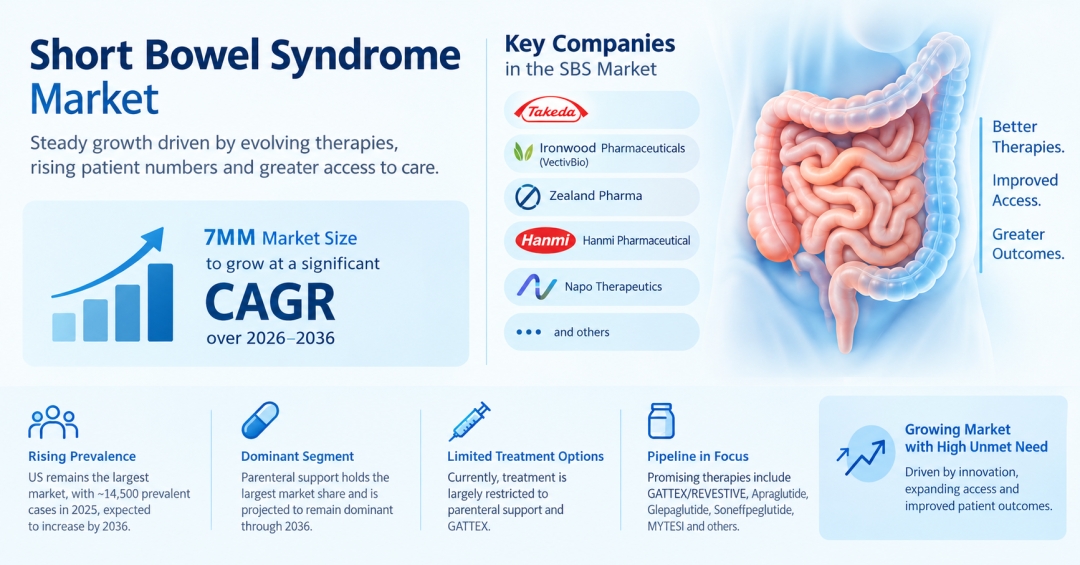
(Albany, US), October 27, 2026 – DelveInsight’s ‘Short Bowel Syndrome Market Insights, Epidemiology and Market Forecast – 2036’ report delivers an in-depth understanding of Short Bowel Syndrome, historical and forecasted epidemiology, as well as the Short Bowel Syndrome market trends in the United States, EU4 (Germany, Spain, Italy, and France) and the United Kingdom, and Japan.
Explore the intricate details of the Short Bowel Syndrome Market Report @ Short Bowel Syndrome Market
Key Takeaways from the Short Bowel Syndrome Market Report
-
In June 2026, Eli Lilly entered into a USD 1.26 billion global licensing agreement with Hanmi Pharmaceuticals for sonefpeglutide, a long-acting GLP-2 analogue under development for short bowel syndrome (SBS). The agreement assigned Lilly development, manufacturing, and commercialization responsibilities across most markets, leveraging its resources to advance clinical development and support future manufacturing and supply capabilities.
-
In May 2026, Takeda Canada announced that BC PharmaCare had added Revestive (teduglutide for injection) to its provincial formulary for eligible pediatric and adult patients with SBS who depend on parenteral support. This inclusion is expected to improve access to reimbursed treatment in British Columbia and facilitate adoption through publicly funded healthcare coverage.
-
According to DelveInsight’s analysis, the 7MM Short Bowel Syndrome market was valued at approximately USD 2,500 million in 2025 and is projected to reach approximately USD 4,100 million by 2036, growing at a CAGR of about 5% during 2026-2036.
-
In 2025, the United States market was valued at USD 2,000 million and is projected to increase by 2036, while the EU4 and the UK market is projected to expand steadily from USD 200 million in 2025 through 2036.
-
According to DelveInsight’s estimates, there were approximately 14,500 diagnosed prevalent cases of SBS in the US in 2025, the highest number among the 7MM, and these are projected to increase by 2036.
-
Among all the therapies in the 7MM, parenteral support held the highest market share in 2025 and is projected to maintain its dominant position through 2036.
-
In the US, adults represent the largest share (~85%) of diagnosed prevalent SBS cases, a shift driven by rising surgical volumes, an aging population, and improved post-surgical survival over the past two decades.
-
SBS treatment remains limited to parenteral support and GATTEX, with parenteral support dominating as the standard of care given its widespread use and comparatively lower cost.
-
GATTEX still requires daily subcutaneous injections owing to its relatively short half-life, and its lyophilized powder formulation involves a complicated reconstitution process prior to administration.
-
The leading Short Bowel Syndrome Companies include Takeda, Ironwood Pharmaceuticals (VectivBio), Zealand Pharma, Hanmi Pharmaceutical, Napo Therapeutics, and others.
-
Promising Short Bowel Syndrome Therapies include GATTEX/REVESTIVE (teduglutide), Apraglutide, Glepaglutide (ZP1848), Sonefpeglutide (HM15912), MYTESI (crofelemer), and others.
Get a Free sample for the Short Bowel Syndrome Market Forecast, Size & Share Analysis Report @ Short Bowel Syndrome Drug Market
Short Bowel Syndrome Overview
Short Bowel Syndrome (SBS) is a complex condition caused by the loss or dysfunction of portions of the small and/or large intestine, resulting in reduced absorption of nutrients, fluids, and electrolytes. It commonly presents with severe diarrhea, dehydration, malnutrition, and weight loss, and in some cases may become life-threatening, although it can often be managed despite having no cure. In adults, the normal small bowel length ranges from 275–850 cm, and SBS is typically defined as having less than 180–200 cm of remaining small intestine, often necessitating nutritional support. Most cases arise from major bowel resection, and prognosis largely depends on age and underlying disease, with around two-thirds of patients surviving the first year. SBS is diagnosed through medical history, physical examination, and tests such as blood work, fecal fat analysis, and imaging, with additional procedures like endoscopy or liver biopsy to assess complications.
Short Bowel Syndrome Epidemiology Segmentation in the 7MM
-
Total Diagnosed Prevalent Cases of SBS
-
Gender-specific Diagnosed Prevalent Cases of SBS
-
Age-specific Diagnosed Prevalent Cases of SBS
-
Etiology-specific Diagnosed Prevalent Cases of SBS
Download the report to understand which factors are driving Short Bowel Syndrome Epidemiology trends @ US Malabsorption Syndrome Market
Short Bowel Syndrome Epidemiology Key Findings
-
The US is recognized for having one of the world’s most advanced HPN programs, which plays a crucial role in supporting long-term survival for patients with chronic intestinal failure. In 2025, among the 7MM, the US had the highest number of diagnosed prevalent cases of SBS.
-
SBS is more commonly diagnosed in women than men, with over 60% of cases occurring in females, compared to more than 30% in males in the US. Gender-specific diagnosed prevalence is expected to increase for both groups during the forecast period.
-
SBS prevalence is higher in adults due to chronic conditions like Crohn’s disease and mesenteric ischemia, whereas pediatric SBS incidence is higher because it often results from acute congenital or neonatal conditions such as necrotizing enterocolitis and intestinal malformations.
-
Pediatric SBS survivors transitioning into adulthood further expand the chronic adult SBS population, adding to prevalence beyond new adult-onset cases.
-
The prevalence of home parenteral nutrition for SBS is generally higher in the US than in Europe. US data often report annual prevalence rates, whereas European studies present point prevalence.
Approved Therapies for Short Bowel Syndrome
-
GATTEX/REVESTIVE (teduglutide): Takeda (Shire Pharmaceuticals)
Teduglutide is a novel, recombinant analogue of human GLP-2, a naturally occurring protein involved in the rehabilitation of the intestinal lining. It has been developed to reduce dependence on parenteral nutrition in adult patients with SBS. Teduglutide has received ODD for the treatment of SBS from the EMA and the US FDA. In 2012, GATTEX was approved by the US FDA for the treatment of SBS. Recombinant human growth hormone (ZORBTIVE), FDA-approved in 2003, has seen declining use due to limited efficacy and safety concerns.
Short Bowel Syndrome Pipeline Analysis
-
Apraglutide: Ironwood Pharmaceuticals (VectivBio)
Apraglutide is an investigational, next-generation, long-acting synthetic GLP-2 analog being developed for a range of rare gastrointestinal diseases where GLP-2 can play a central role in addressing disease pathophysiology, including SBS-IF. Following discussions with the US FDA in April 2025, a confirmatory Phase III trial is needed to seek approval of apraglutide for patients with SBS-IF who are dependent on parenteral support. Pending alignment with the FDA, Ironwood expects to initiate a confirmatory Phase III trial in the 1H of 2026.
-
Glepaglutide (ZP1848): Zealand Pharma
Glepaglutide is a long-acting GLP-2 analog in development as a potential treatment option for SBS. It is being developed as a liquid product in an autoinjector designed for subcutaneous administration, aimed to reduce or eliminate the need for parenteral support in people living with SBS. The US FDA has granted ODD for glepaglutide for the treatment of SBS. The company had completed the Type A meeting with the US FDA, ensuring alignment on the design of EASE-5, and anticipated the initiation of the Phase III trial (EASE-5) in H2 2025 to support resubmission in the US.
Discover more about therapies set to grab Major Short Bowel Syndrome Market Share @ GLP-2 Analogs Market
Short Bowel Syndrome Market Outlook
The Short Bowel Syndrome market is evolving from reliance on total parenteral nutrition (TPN), the current cornerstone despite its cost, risks, and long-term burden, toward advanced therapies that reduce dependence on parenteral support. Growing use of GLP-2 analogs such as GATTEX/REVESTIVE, along with emerging next-generation agents like apraglutide offering improved efficacy and convenient dosing, is driving this shift. With declining use of older growth hormone therapies and a strong focus on achieving intestinal autonomy, the SBS market is poised for significant growth, supported by innovation in biologics and ongoing pipeline advancements. The EU4 and the UK market is supported by favorable orphan drug incentives, well-established healthcare infrastructure, and a growing shift toward disease-modifying therapies in place of long-term parenteral nutrition. Alongside this, readers tracking the wider gastrointestinal space may also follow related segments such as the ogilvie syndrome treatment market, malabsorption syndrome market, hirschsprungs disease treatment market, and intestinal ischemia market.
Short Bowel Syndrome Market Drivers
-
Increasing cases of conditions like Crohn’s disease, necrotizing enterocolitis, and gastrointestinal surgeries, especially in neonates and the elderly
-
Launch of GLP-2 analogs such as apraglutide, glepaglutide, and HM15912, expected to reduce parenteral nutrition dependence and improve patient outcomes
-
Rising surgical volumes, an aging population, and improved post-surgical survival
-
Growing focus on achieving intestinal autonomy
Short Bowel Syndrome Market Barriers
-
High Treatment Costs: Expensive therapies and long-term nutritional support limit patient access and affordability.
-
Limited Treatment Options: Few approved therapies address the underlying complications of Short Bowel Syndrome.
-
Complex Disease Management: Patients often require prolonged parenteral nutrition, specialized monitoring, and multidisciplinary care.
-
Safety and Tolerability Concerns: Adverse effects and potential complications associated with long-term treatments may restrict adoption.
-
Regulatory and Clinical Challenges: Disease rarity, small patient populations, and complex clinical trial endpoints hinder drug development.
Short Bowel Syndrome Treatment Landscape
Treatment of SBS is complex and individualized, focusing on maintaining nutrition, enhancing intestinal adaptation, and managing complications through approaches such as TPN, enteral feeding, dietary modifications, oral rehydration, medications, and, in severe cases, surgery or intestinal transplantation. Mild cases may be managed with diet and anti-diarrheal therapy, while many patients require TPN, though newer therapies like growth hormone and GLP-2 analogs have reduced long-term dependence. Medications include anti-diarrheals, acid-suppressing agents, and absorption-enhancing drugs, with antibiotics or enzyme therapy used when needed. Surgical options, reserved for refractory cases, include bowel-lengthening procedures (e.g., STEP, Bianchi) and, in severe cases, small bowel transplantation. Key unmet needs include limited therapeutic options, therapeutic gaps across pediatric patients, long-term nutritional independence, and high cost and disturbed quality of life.
To know more about Short Bowel Syndrome Companies working in the treatment market, visit @ Short Bowel Syndrome Drugs Market
Scope of the Short Bowel Syndrome Market Report
-
Coverage: 7MM
-
Study Period: 2022-2036
-
Forecast Period: 2026-2036
-
Short Bowel Syndrome Companies: Takeda, Ironwood Pharmaceuticals (VectivBio), Zealand Pharma, Hanmi Pharmaceutical, Napo Therapeutics, and others.
-
Short Bowel Syndrome Therapies: GATTEX/REVESTIVE (teduglutide), Apraglutide, Glepaglutide (ZP1848), Sonefpeglutide (HM15912), MYTESI (crofelemer), and others.
-
Short Bowel Syndrome Market Dynamics: market drivers and market barriers
-
Short Bowel Syndrome Competitive Intelligence Analysis: SWOT Analysis, Conjoint Analysis
-
Short Bowel Syndrome Unmet Needs, KOL Views, Reimbursement
Table of Contents
-
Key Insights
-
Report Introduction
-
Executive Summary of SBS
-
Key Events
-
Epidemiology and Market Methodology
-
SBS Market Overview at a Glance
-
Disease Background and Overview of Short Bowel Syndrome
-
Treatment of Short Bowel Syndrome
-
Epidemiology and Patient Population of Short Bowel Syndrome
-
Patient Journey of Short Bowel Syndrome
-
Marketed Therapy
-
Emerging Drugs
-
SBS: 7MM Market Analysis
-
Unmet Needs of Short Bowel Syndrome
-
SWOT Analysis of Short Bowel Syndrome
-
KOL Views of Short Bowel Syndrome
-
Market Access and Reimbursement of Short Bowel Syndrome
-
Appendix
-
DelveInsight Capabilities
-
Disclaimer
-
About DelveInsight
Media Contact
Company Name: DelveInsight Business Research LLP
Contact Person: Abhishek kumar
Email: Send Email
Phone: +19193216187
Address:304 S. Jones Blvd #2432
City: Albany
State: New York
Country: United States
Website: https://www.delveinsight.com/report-store/short-bowel-syndrome-market


