
Hip Resurfacing Implants Market to Reach USD 1.21 Billion by 2031, Driven by Ceramic Implant Innovation and Bone-Conserving Procedures
Hyderabad, India, November 27, 2026:
Hip Resurfacing Implants Market Overview
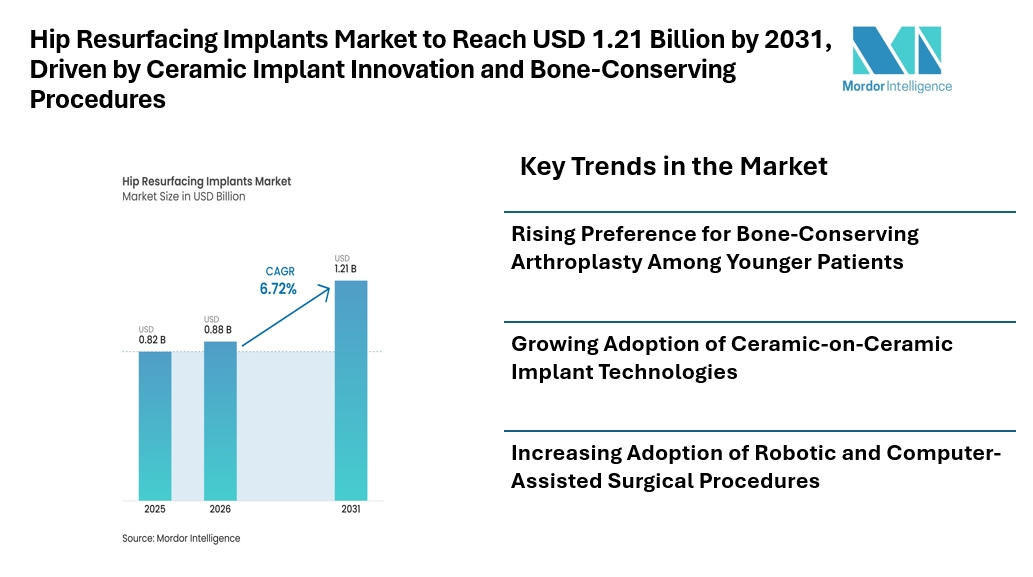
According to Mordor Intelligence, the hip resurfacing implants market size is estimated at USD 0.88 billion in 2026 and is projected to reach USD 1.21 billion by 2031, registering a CAGR of 6.72% during the forecast period. The market was valued at USD 0.82 billion in 2025, reflecting increasing demand for bone-preserving orthopedic procedures and advanced implant technologies.
The hip resurfacing implants industry is witnessing growing interest in bone-conserving arthroplasty, particularly among younger and physically active patients seeking to preserve more of their natural bone structure. Advances in ceramic-on-ceramic implant systems are expanding treatment options beyond conventional metal-on-metal devices, addressing concerns related to metal-ion release and adverse tissue reactions. Additionally, the adoption of robotic-assisted surgery, computer-aided component positioning, and cementless fixation technologies is supporting improvements in surgical precision and implant development.
North America held the largest regional share of the hip resurfacing implants market in 2025, accounting for 42.41% of global revenue, supported by advanced orthopedic infrastructure, established reimbursement systems, and early adoption of navigation-assisted procedures. Asia-Pacific is expected to register the fastest growth during the forecast period, with a projected CAGR of 8.05%, driven by expanding orthopedic healthcare infrastructure, rising surgical demand, and increasing investments in private healthcare facilities.
Report Overview: https://www.mordorintelligence.com/industry-reports/hip-resurfacing-implants-market?utm_source=abnewswire
Hip Resurfacing Implants Market Trends
Rising Preference for Bone-Conserving Arthroplasty Among Younger Patients
Hip resurfacing is gaining attention as a bone-preserving alternative to conventional total hip replacement, particularly among younger patients with high functional expectations. Unlike traditional hip replacement procedures that involve removing the femoral head, hip resurfacing preserves more of the patient’s natural bone structure. This approach can be relevant for patients under 55 who may require revision procedures during their lifetime.
Clinical evidence has also supported the use of hip resurfacing among appropriately selected younger and physically active patients. A 2024 Bone & Joint study reported low complication and revision rates among younger male patients with end-stage hip disease who underwent hip resurfacing arthroplasty. The findings also highlighted the potential for returning to high-impact physical activities when procedures are performed by experienced, high-volume surgeons. These clinical advantages are supporting continued interest in bone-conserving orthopedic procedures.
Growing Adoption of Ceramic-on-Ceramic Implant Technologies
The development of ceramic-on-ceramic hip resurfacing implants is expanding treatment possibilities and addressing some of the limitations associated with conventional metal-on-metal systems. Concerns regarding metal-ion release, pseudotumors, and adverse local tissue reactions have encouraged manufacturers to explore alternative bearing materials with improved wear characteristics.
Ceramic technologies are also expanding patient eligibility, particularly among women and individuals with smaller femoral head anatomy who were previously less suitable for conventional metal resurfacing systems. The H1 ceramic-on-ceramic implant received CE marking under the EU Medical Device Regulation in July 2025, representing an important development in non-metal hip resurfacing technology. Continued advancements in ceramic materials, implant design, and clinical validation are expected to support adoption of these systems.
Increasing Adoption of Robotic and Computer-Assisted Surgical Procedures
Robotic-assisted surgery and computer-aided planning are becoming increasingly relevant in hip resurfacing procedures, where accurate femoral component alignment and bone preparation are important for surgical outcomes. These technologies support surgeons in evaluating patient anatomy, planning implant positioning, and improving procedural consistency.
The adoption of robotic assistance is expanding across orthopedic centers in North America, Western Europe, Japan, and South Korea. In the United States, robotic assistance accounted for 6.6% of elective primary total hip arthroplasty procedures in 2023. Additionally, NHS Scotland recorded an increase in robotic joint replacements from 101 procedures in 2020 to 1,164 procedures in 2024. These developments highlight the growing integration of technology into orthopedic surgery and are supporting demand for compatible implant systems and specialized surgical instrumentation.
Expanding Diagnosis and Surgical Treatment of Hip Osteoarthritis
The increasing prevalence of hip osteoarthritis is supporting demand for advanced orthopedic treatment options, including hip resurfacing procedures. Population aging, obesity, and changing activity patterns are contributing to the growing burden of degenerative joint conditions. Improved diagnostic capabilities, including magnetic resonance imaging and advanced orthopedic assessments, are also supporting earlier identification of patients requiring surgical intervention.
Hip resurfacing is particularly relevant for selected patients with advanced hip osteoarthritis who wish to preserve bone and maintain higher activity levels. Growing orthopedic capacity in emerging economies, alongside expanding private healthcare infrastructure, is expected to improve access to specialized surgical procedures. These developments are supporting long-term demand for hip resurfacing implants across established and developing healthcare markets.
For more insights on the Japanese market report, please visit the Mordor Intelligence page: https://www.mordorintelligence.com/ja/industry-reports/hip-resurfacing-implants-market?utm_source=abnewswire
Hip Resurfacing Implants Market Segmentation
The hip resurfacing implants market is segmented by product type, material and bearing couple, fixation type, indication, end user, and geography.
-
By Product Type
-
Metal-on-Metal Hip Resurfacing Implants
-
Ceramic-on-Ceramic Hip Resurfacing Implants
-
Metal-on-Polyethylene Hip Resurfacing Implants
-
Hybrid Hip Resurfacing Implants
-
Other Product Types
-
By Material and Bearing Couple
-
Cobalt-Chromium Alloy
-
Titanium Alloy
-
Alumina and Zirconia-Toughened Ceramic
-
Highly Cross-Linked Polyethylene
-
Ceramic-on-Metal and Other Bearing Couples
-
By Fixation Type
-
Cemented Femoral Component
-
Cementless Femoral Component
-
Cementless Acetabular Component
-
Hybrid Fixation
-
By Indication
-
Primary Osteoarthritis
-
Rheumatoid Arthritis
-
Hip Dysplasia
-
Avascular Necrosis
-
Post-Traumatic Arthritis
-
By End User
-
Hospitals
-
Orthopedic Clinics
-
Ambulatory Surgical Centers
-
Other End Users
-
By Geography
-
North America
-
United States
-
Canada
-
Mexico
-
Europe
-
Germany
-
United Kingdom
-
France
-
Italy
-
Spain
-
Rest of Europe
-
Asia-Pacific
-
China
-
Japan
-
India
-
Australia
-
South Korea
-
Rest of Asia-Pacific
-
Middle East and Africa
-
GCC
-
South Africa
-
Rest of Middle East and Africa
-
South America
-
Brazil
-
Argentina
-
Rest of South America
Hip Resurfacing Implants Market Competitive Landscape
The hip resurfacing implants market is moderately concentrated, with established orthopedic device manufacturers and specialized implant developers competing through product innovation, material advancements, and surgeon-focused clinical programs. Companies are increasingly focusing on ceramic bearing technologies, cementless fixation systems, and specialized implant designs to address evolving patient requirements.
The competitive landscape is being shaped by developments in non-metal implant technologies and regulatory approvals for advanced resurfacing systems. Manufacturers are also investing in clinical evidence, surgeon education, and strategic collaborations to strengthen their market presence. The discontinuation of Birmingham Hip Resurfacing manufacturing by Smith & Nephew in 2024 has further influenced the competitive environment, creating opportunities for alternative implant technologies.
Key Players in the Hip Resurfacing Implants Market
-
Smith & Nephew
-
Zimmer Biomet
-
Stryker Corporation
-
Corin Group
-
Johnson & Johnson
-
MatOrtho
-
JointMedica
-
Embody Orthopaedic
-
LimaCorporate
-
Medacta International
-
MicroPort Orthopedics
-
United Orthopedic Corporation
-
B. Braun
-
Exactech
-
Mathys
-
OMNI Life Science
-
Aesculap Implant Systems
Conclusion
The hip resurfacing implants market is expected to maintain steady growth as demand for bone-conserving orthopedic procedures, advanced ceramic implant technologies, and robotic-assisted surgical solutions continues to increase. Improvements in implant materials and fixation technologies are expanding treatment options, particularly for younger and physically active patients seeking alternatives to conventional total hip replacement.
North America is expected to retain its leading regional position, while Asia-Pacific is projected to register the fastest growth during the forecast period. Despite challenges associated with metal-ion release concerns, regulatory scrutiny, surgeon training requirements, and reimbursement limitations, continued innovation in ceramic implants and increasing investments in orthopedic healthcare infrastructure are expected to support market expansion.
About Mordor Intelligence
Mordor Intelligence is a global market intelligence firm, founded in 2014, helping businesses make informed decisions through data-driven insights, industry expertise, and advanced analytics. With 550+ domain experts and on-ground specialists across 150+ countries, the company delivers comprehensive intelligence across aerospace & defense, agriculture, automation, automotive, chemicals & materials, consumer goods & services, electronics, energy & power, financial services, food & beverages, healthcare, hospitality & tourism, information & communications technology, and logistics.
Its offerings include syndicated industry reports and subscription platforms such as Synapse. Mordor Intelligence is ISO 9001:2015 and ISO/IEC 27001:2022 certified, a member of ESOMAR and the Market Research Society of India, and a four-time Great Place to Work® honoree. Learn more at mordorintelligence.com.
Media Contact
Company Name: Mordor Intelligence Private Limited
Contact Person: Jignesh Thakkar
Email: Send Email
Phone: +1 617-765-2493
Address:11th Floor, Rajapushpa Summit, Nanakramguda Rd, Financial District, Gachibowli
City: Hyderabad
State: Telangana 500008
Country: India
Website: https://www.mordorintelligence.com/


